
- Remove the current class from the content27_link item as Webflows native current state will automatically be applied.
- To add interactions which automatically expand and collapse sections in the table of contents select the content27_h-trigger element, add an element trigger and select Mouse click (tap)
- For the 1st click select the custom animation Content 27 table of contents [Expand] and for the 2nd click select the custom animation Content 27 table of contents [Collapse].
- In the Trigger Settings, deselect all checkboxes other than Desktop and above. This disables the interaction on tablet and below to prevent bugs when scrolling.
A hamstring injury is one of the most common, and most frustrating, setbacks in professional soccer. The tissue heals, the player feels ready, they return to play, and then it happens again. For Jamie Blair, Performance Coach with Charlotte FC's Crown Legacy second team, breaking that cycle meant looking past the injury itself and asking a harder question. What was actually causing it?
That question changed how his team approaches rehab.
The Problem Wasn't the Injury. It Was the Movement.
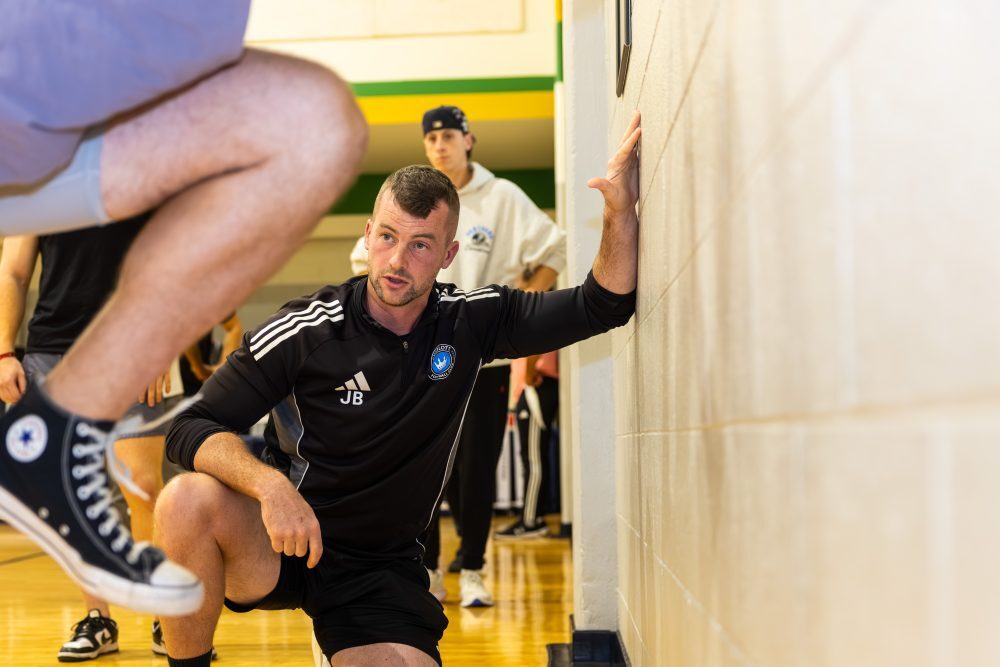
Jamie has spent four years with Charlotte FC, overseeing on-field loading, gym programming, and athlete rehabilitation for the second team. His technology stack is already serious, including Catapult GPS and Hawkin Dynamics force plates. But when it came to understanding acceleration and max velocity mechanics, something was missing.
"I've always used cameras for assessing gait," Jamie explained, "but it's been pretty much along the lines of pausing the video, pointing to a key frame and analyzing it." A standard iPhone camera could show him something was off. It couldn't tell him precisely what, or by how much.
When one of his athletes suffered a hamstring injury and then a reinjury, Jamie suspected the real culprit wasn't bad luck. It was mechanics. Specifically, excessive backside mechanics and poor pelvic positioning were creating a significant separation between the thighs at initial ground contact. Put simply, the athlete's movement pattern was working against him, wasting time and force with every stride.
As Jamie put it, athletes often pick up hamstring injuries not because they're unlucky, but because they haven't built the physical robustness to keep using flawed mechanics without consequence.
Making the Invisible, Visible
This is where VueMotion came in. Instead of relying on a paused video frame and a hunch, Jamie used VueMotion to capture detailed Kinograms, frame-by-frame visual breakdowns of the athlete's movement at the point of contact, and test them at structured 7, 14, and 21-day intervals throughout the rehab.
Jamie’s tailored program focused not just on healing, but on correcting the anomalies in the athlete’s movement patterns that VueMotion highlighted.
The data told a clear story over the three testing checkpoints:
- The exaggerated thigh separation at touchdown steadily decreased
- Contact times got noticeably quicker
- Entry speeds on the 20-meter test improved with each test
But the real breakthrough wasn't just in the numbers. It was in how Jamie used them with his athlete. Verbal reassurance only goes so far with a player anxious about reinjury. Visual proof is different. Jamie could show the athlete a Kinogram from 11 days earlier next to a current one and say: this was you then, this is you now, and the work you're putting in is making a difference.
That kind of evidence-based feedback loop didn't just inform the rehab plan. It kept the athlete engaged and bought in at every stage.
A Faster Return, Built to Last
The projected rehab timeline was roughly four weeks. The athlete returned to play in slightly less time than that, which is a meaningful result on its own. But the more important outcome came later.
Months after returning to competition, the athlete was still demonstrating the corrected movement mechanics, including under fatigue, when old habits are most likely to resurface. The rehab hadn't just patched the injury. It had permanently changed how the athlete moved.
For Jamie, this validates an approach centered on intention and awareness. Small, consistent adjustments to movement strategy compound into lasting results.
What This Means Beyond One Rehab
Charlotte FC's experience reflects a broader shift happening across performance and medical teams, away from symptom management and toward root-cause correction. Instead of asking an athlete how they feel, staff are increasingly asking what the data shows.
A few things stand out from how Jamie applied this in practice. Visual evidence seems to matter more for athlete buy-in than verbal reassurance ever does, people believe what they can see. Structured checkpoints, rather than a single pass or fail test at the end, gave Jamie the confidence to bring his athlete back early without cutting corners.
Going after the underlying mechanical flaw rather than just treating the healed tissue is what actually protects against the injury happening again. And maybe most telling of all, the real test of whether a correction worked isn't how an athlete moves in a clean, controlled session. It's how they move months later, tired, mid-game, not thinking about their mechanics at all.
Jamie is already looking ahead, with plans to expand his use of VueMotion into deceleration and change of direction testing, giving his rehab programs an even more complete picture of how his athletes move, and why.
Want to see how VueMotion can support your rehab and performance programs? Get in touch to learn more.