
- Remove the current class from the content27_link item as Webflows native current state will automatically be applied.
- To add interactions which automatically expand and collapse sections in the table of contents select the content27_h-trigger element, add an element trigger and select Mouse click (tap)
- For the 1st click select the custom animation Content 27 table of contents [Expand] and for the 2nd click select the custom animation Content 27 table of contents [Collapse].
- In the Trigger Settings, deselect all checkboxes other than Desktop and above. This disables the interaction on tablet and below to prevent bugs when scrolling.
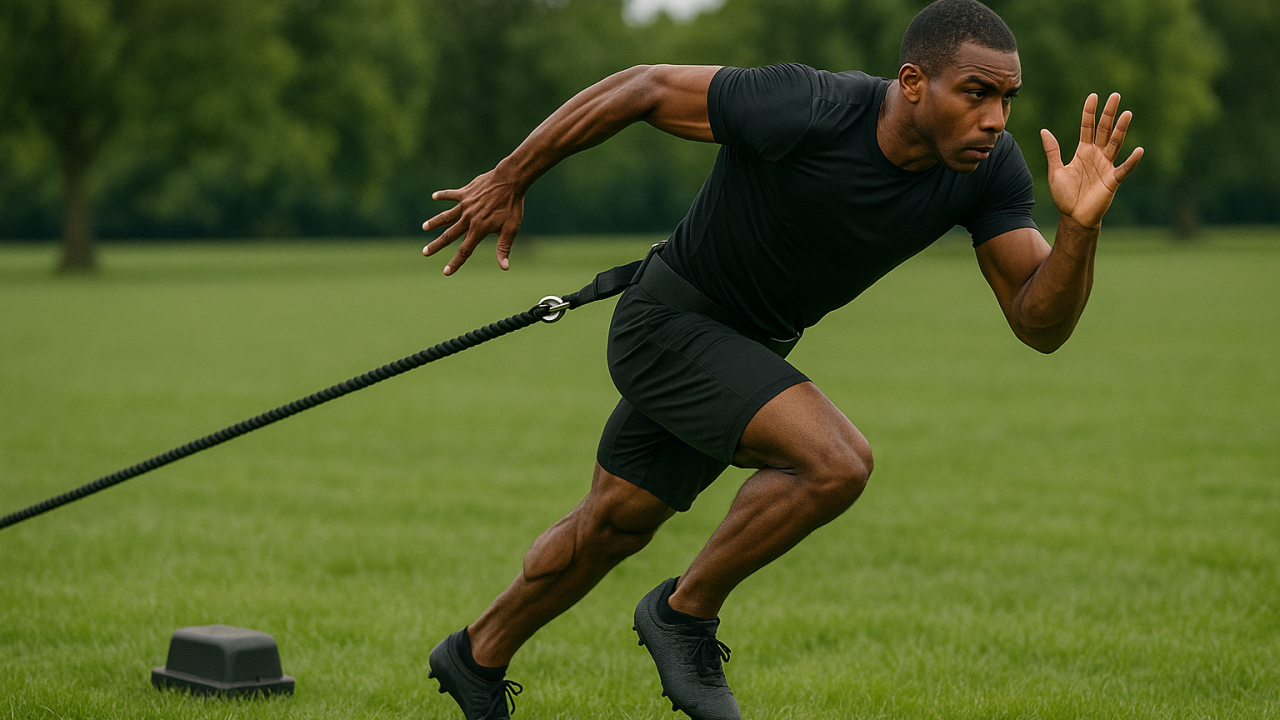
Over the past decade, we’ve seen a surge in resistance training tools across sports performance and rehabilitation. What began with simple sleds has evolved into a range of motorised systems on the market that apply controlled horizontal resistance, and tracks time, speed and step metrics.
Working in biomechanics and movement intelligence across professional, semi-professional and academy environments, VueMotion has watched coaches and practitioners expand their toolkits to include resistance training and many also, pairing resistance training with video based movement analysis for acceleration, upright running, deceleration, lateral movements, and change of direction.
Resistance can be effective when used well. But before we go “all in” because everyone else is doing it, it’s important to understand not just the potential benefits, but also the short and long-term impacts on an athlete.
Movement is a language, and athletes must learn that language so the brain can organise, coordinate, and communicate with the body to move quickly, generate force, and transfer it efficiently.
Speed = step length × step frequency. To improve speed and performance, athletes need to optimise those parameters.
Resistance training, however, reduces step length, reduces step frequency, increases ground contact time, reduces flight time, and shifts biomechanical behaviours and motor patterns. Trying to speed athletes up by first slowing them down is a contradiction of biomechanics, motor learning, and basic physics. There is empirical evidence that introducing altered loads in other areas of training (heavier/lighter implements) affects accuracy and speed e.g., heavier balls = slow ball speed and reduce accuracy. This same principle applies to sprinting.
This matters because humans adapt to the stimulus of their training environment. One example is something called “rhythm lock,” a term first introduced to me by sprint coach Stacey Taurima. This effect is where an athlete synchronises their timing and movement strategy to someone else when walking, jogging, running, or sprinting. Track coaches often see this when athletes run together, but for most people the brain largely ignores it unless you’re trained to notice it.
I first started recognised this early in my career working in surveillance. For years I observed crowds through camera systems in public spaces. We had no audio, only movement. That developed a deep understanding of human behaviour and locomotion. Later, when coaching track & field, I noticed how strongly athletes adapt to who they move with. That led me down the path of trying to measure what was changing using data and video.
In Dean Benton’s book, he highlights that resistance can be beneficial in the first 5–7 metres of acceleration which also supports Myrvang’s recent 2024 study, but only if it doesn’t come at the expense of an athlete’s biomechanics. Resistance training may offer benefits to some athletes, however it often encourages adaptations toward moving slower, altering the mechanics that drive speed and performance, and increasing injury risk. This becomes an even bigger concern in team-based sports, where the compounding effect of mechanical inefficiency places greater stress on the energy systems, CNS and overall physical load.
So the real question is: How do you use resistance training to your advantage and how do you know whether it’s helping or hindering an athlete?
VueMotion’s automated Kinograms provide a detailed profile of how an athlete moves, how they coordinate their limbs at speed, how they generate and transfer forces, and how these patterns change with and without resistance.
The Kinograms show that resistance can promote a more optimal trunk lean in acceleration. But the trade offs are clear: longer ground contact times, increased ankle collapse, a straighter leg at toe-off with the leg travelling further behind the body, lower foot height that is needed to punch the ground to create force the project the body forward, and reduced thigh separation. These changes affect how momentum, gravity, and force interact to create efficiency and they undermine key foundations of effective sprint mechanics.
As a general rule, context and movement efficiency must come before increased resistance. Athletes may appear to be getting “faster” simply through general training adaptation while simultaneously becoming less efficient. That’s why objective measurement matters. Athletes must earn the right to load.
This is where VueMotion becomes a powerful tool for coaches and teams. It provides an objective way to measure and track what’s changing, and a smarter way to integrate resistance training without compromising long-term development.
With consistent testing using video analysis, Kinograms, Augmented videos and, data you can trust, you can confidently track whether an athlete is progressing or regressing biomechanically and make informed decisions that protect your most valuable asset: the athlete.