

- Remove the current class from the content27_link item as Webflows native current state will automatically be applied.
- To add interactions which automatically expand and collapse sections in the table of contents select the content27_h-trigger element, add an element trigger and select Mouse click (tap)
- For the 1st click select the custom animation Content 27 table of contents [Expand] and for the 2nd click select the custom animation Content 27 table of contents [Collapse].
- In the Trigger Settings, deselect all checkboxes other than Desktop and above. This disables the interaction on tablet and below to prevent bugs when scrolling.
From 2 to 4 October 2026, coaches, sport scientists, researchers and performance practitioners came together at Etihad Stadium in Manchester for the Sportsmith Speed Training Conference.
This year’s theme was The Evolution of Multidirectional Speed, with three days dedicated to exploring how athletes develop, control and express speed in the complex environments of sport.
VueMotion’s Ryan Talbot and Liam Walker made the trip to Manchester to be part of the event, connect with practitioners and customers, and hear first-hand how some of the industry’s leading coaches and researchers are thinking about speed development.
It was much more than a conference about running faster.
The program explored acceleration, deceleration, change of direction, plyometrics, biomechanics, game speed and the bigger challenge of transferring physical qualities from training into competition.
Here’s a look at what happened and what we took away from the three days.
What was Sportsmith 2026 about?
At the centre of this year’s conference was a simple question:
What does speed actually look like in sport?
Traditional speed testing often gives us clear outcomes.
A 10-meter time.
An average speed
A change-of-direction time.
Those measures remain important, but competitive sport rarely asks an athlete to simply sprint from point A to point B.
Athletes accelerate and decelerate. They run curves. They cut at different angles. They respond to opponents and space. They reposition their bodies and accelerate again.
The Sportsmith conference examined these different demands under the wider concept of multidirectional speed.
Across lectures and practical sessions, speakers discussed both the physical qualities that underpin these movements and how coaches can develop them in real sporting environments.
From linear speed to multidirectional speed
One of the key contributors to the program was Les Spellman, whose work explored the progression from linear speed into multidirectional speed.
Linear speed provides an important foundation.
Acceleration mechanics, maximum velocity and an athlete’s ability to produce force all contribute to how quickly they can move.
But once direction changes, the movement problem changes too.
An athlete may need to manage momentum, alter body position, apply force in a different direction and then accelerate into a new path.
The challenge for coaches is therefore not simply developing faster athletes.
It’s helping athletes access and express speed when the sporting environment demands it.
That distinction between speed capacity and speed expression became an important theme throughout the conference.
Breaking down change of direction
Lachlan Wilmot’s contribution took a closer look at change-of-direction performance.
Rather than treating change of direction as one general ability, the session examined different actions, including:
Curved running, where athletes change their path while attempting to maintain velocity.
Single-step angle changes, where athletes redirect their movement through a relatively rapid action.
Deceleration-driven changes, where athletes must significantly reduce momentum before reorganising and accelerating in another direction.
This distinction is important because each movement presents the athlete with a different physical problem and coordination demands.
Running a curve is not mechanically identical to making a sharp 180-degree turn.
Yet both might broadly be described as change of direction.
For practitioners, this raises an important question when selecting assessments:
What movement are we actually trying to understand?
Why braking became part of the speed conversation
Acceleration gets plenty of attention in performance training.
Sportsmith also put considerable focus on the other side of the equation: deceleration.
In multidirectional sport, athletes repeatedly need to rapidly reduce velocity before they can effectively redirect it.
A typical sequence may look like:
Accelerate → Decelerate → Reposition → Redirect → Reaccelerate
That makes braking part of speed performance rather than something separate from it.
How an athlete manages momentum before a directional change can influence the position they arrive in and their ability to move effectively afterwards.
It also demonstrates why a test time alone doesn’t always explain everything that happened during the movement.
Two athletes might complete a change-of-direction drill at the same time while using different strategies to decelerate, turn and re-accelerate.
The outcome is the same.
The movement isn’t necessarily the same.
Movement Re-Education: A T-Shaped Approach
Elite speed coach Jonas Dodoo presented a session focused on the idea that developing highly explosive athletes who can perform consistently week after week requires looking past a single specialization. He advocated for modern performance practitioners to become "T-shaped"—meaning they possess deep technical expertise in their primary field, while maintaining a broad enough understanding of other interconnected disciplines.
He demonstrated how the following areas must interact to optimize athletic output and consistency:
- Movement mechanics and better performance on the pitch
- Rehabilitation and returning to play
- Physical preparation and training design
- Coaching pedagogy and how practitioners communicate with players
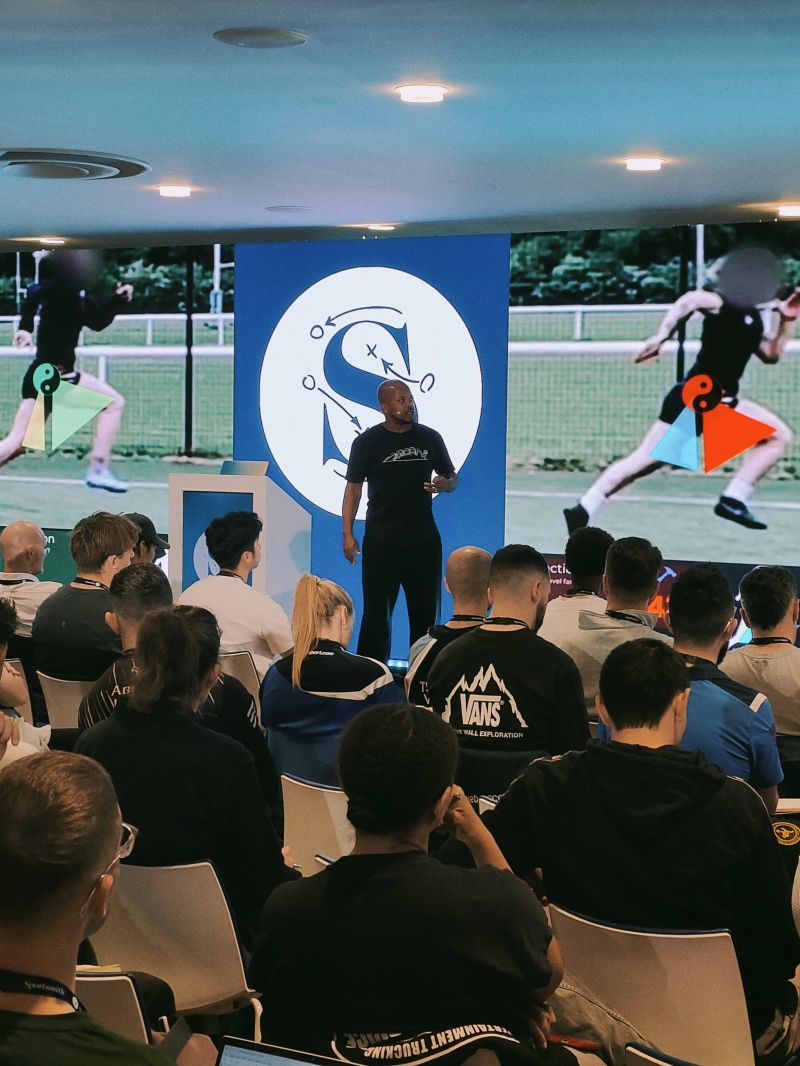
Jonas Dodoo presenting (photo credit: Federico Heredia Barión)
From physical speed to game speed
Pete Burridge brought another perspective to the program through his work on Game Speed.
Being fast in controlled testing conditions doesn’t automatically mean an athlete will appear equally fast during competition.
In a sprint test, the athlete usually knows when to start, where to go and what movement to perform.
Sport adds uncertainty.
An athlete may have to perceive what is happening around them, interpret information, make a decision and then execute the appropriate movement.
That means game speed involves the interaction between physical capacity, perception, decision-making and movement execution.
Burridge’s Prep, Perform, Play framework explored how coaches can connect physical preparation more closely with what athletes eventually need to do in competition.
It raised one of the most interesting questions from the weekend:
How do we know whether what we’re developing in training actually transfers to the game?
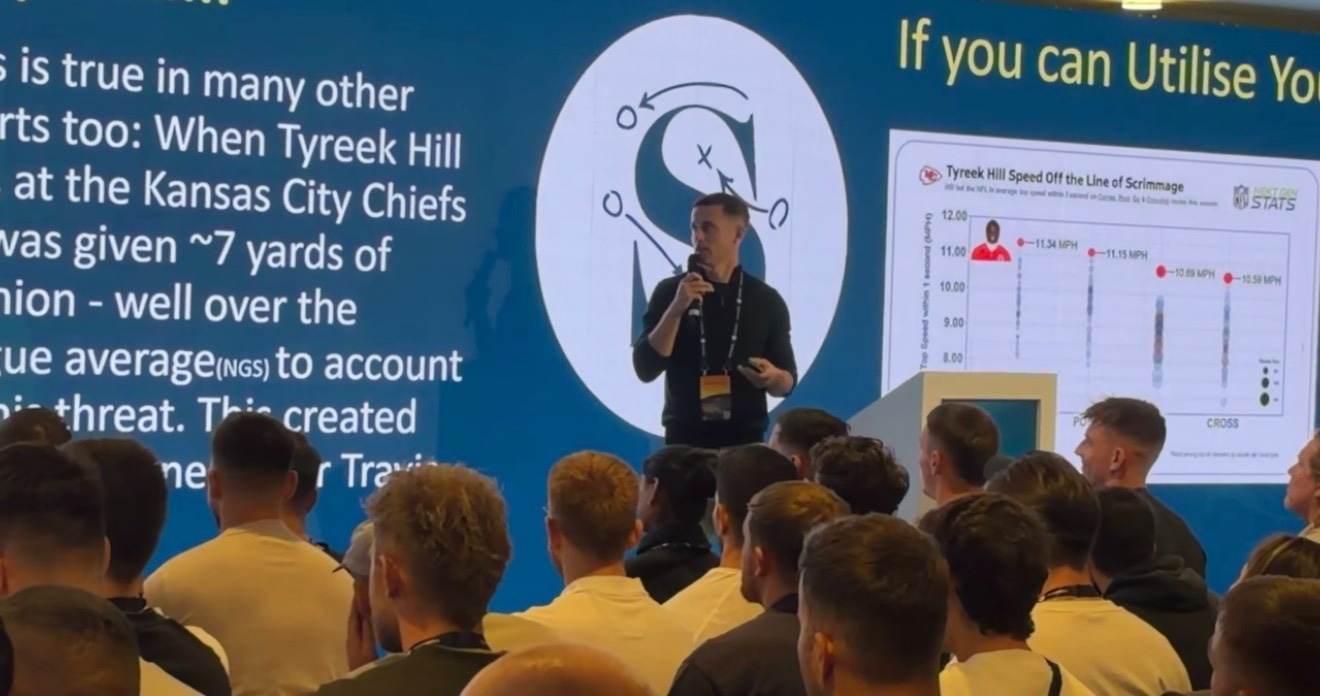
Connecting plyometrics with multidirectional speed
Mike Young’s session, From Plyos to Play: A Modern System for Developing Multi-Directional Speed, explored another part of that pathway.
Plyometric training can help develop qualities associated with explosive athletic movement, but the discussion extended beyond simply performing more jumps.
Multidirectional movement requires several qualities to interact.
Force production.
Elastic qualities.
Coordination.
Body position.
Braking capacity.
Timing.
The challenge is then taking physical qualities developed through training and helping athletes express them in movements relevant to their sport.
Again, the discussion came back to transfer.
Improving an exercise or drill is valuable, but the ultimate objective is improving the athlete.
Practical sessions brought the ideas onto the floor
An important part of Sportsmith was that the program wasn’t confined to presentations.
Practical sessions allowed concepts discussed in the lectures to be demonstrated and explored through movement.
That matters in an area such as multidirectional speed because movement can be difficult to fully understand through numbers or slides alone.
Seeing athletes accelerate, decelerate, reposition and change direction provides context around the metrics practitioners eventually collect.
It also creates an opportunity to ask a different type of question.
Rather than only asking:
How quickly did the athlete complete the movement?
Practitioners can begin asking:
What happened during the movement?
Three days of conversations beyond the program
For Ryan and Liam, some of the most useful moments in Manchester happened between the scheduled sessions.
Sportsmith brought together practitioners from the UK, Europe, the US, Australia and elsewhere, creating plenty of opportunities to compare how different organisations approach athlete development and assessment.
There were conversations with existing VueMotion customers, new connections, coaches and practitioners about movement analysis, testing and the realities of collecting data in high-performance environments.
One theme came up repeatedly.
The industry doesn’t necessarily have a shortage of data.
Many teams already have access to GPS, force plates, timing systems, strength testing, VBT athlete monitoring platforms, video and other technologies.
The bigger challenge is turning all that information into something practitioners can use.
More numbers don’t automatically create more understanding.
The information needs to answer a question.
What does this mean for athlete assessment?
Looking across the entire Sportsmith program, there was an interesting progression.
First, understand the physical capacity.
Then understand the movement.
Then consider the sporting context.
And finally, ask whether training is transferring.
That creates a much broader view of athlete assessment.
A sprint time can tell us what happened.
Movement analysis can help provide context around how it happened.
The coach then adds another layer by understanding why it matters for that athlete and their sport.
These aren’t competing approaches.
They are different pieces of the same performance picture.
Same result. Different story.
One idea from the weekend captures this particularly well.
Imagine two athletes completing exactly the same change-of-direction test.
They record the same time.
If we only look at the final performance metric, there may be very little separating them.
But when we look at the movement itself, we may see something different.
One athlete might begin braking earlier.
Another might carry greater velocity deeper into the movement.
Their body positions may differ.
Their strategies for redirecting momentum may differ.
Their acceleration out of the movement may differ.
One might re-accelerate much faster.
One might be more at risk of injury.
The stopwatch isn’t wrong.
It simply only answers one question.
Movement can help us ask the next one.
Where technology fits
Technology was naturally part of many conversations throughout Sportsmith, but one of the useful reminders from the event was that technology itself isn’t the end goal.
The goal is better information for coaches and practitioners.
That’s something that resonated strongly with Ryan and Liam.
At VueMotion, we make biomechanical movement assessment more accessible outside traditional laboratory environments using smartphone-enabled technology.
Sportsmith gave us the opportunity to speak directly with practitioners about how movement information can sit alongside the tools they’re already using.
Not replacing GPS.
Not replacing force plates.
Not replacing resistance running.
And certainly not replacing coaching expertise.
Instead, adding another perspective to the athlete’s performance profile.
What we brought back from Manchester
After three days of presentations, practical sessions and conversations, our biggest takeaway wasn’t one particular drill or technology.
It was how much the conversation around speed continues to evolve.
Speed isn’t simply acceleration.
Change of direction isn’t one movement.
Deceleration isn’t simply the absence of acceleration.
Testing speed isn’t necessarily the same as game speed.
And improving a training exercise doesn’t automatically guarantee transfer into competition.
For practitioners, that means athlete assessment needs to continue evolving too.
We need the performance outcome.
But increasingly, we also have the opportunity to understand the movement behind it.
A huge thank you to Rob Pacey and the Sportsmith team, the presenters and everyone who took the time to speak with Ryan and Liam during the three days in Manchester.
We came to Sportsmith to listen, learn and share ideas with people working at the pointy end of performance sport.
We left with plenty of new conversations to continue.
And one question that feels more relevant than ever:
We know what the athlete achieved. What can we learn from how they achieved it?