

- Remove the current class from the content27_link item as Webflows native current state will automatically be applied.
- To add interactions which automatically expand and collapse sections in the table of contents select the content27_h-trigger element, add an element trigger and select Mouse click (tap)
- For the 1st click select the custom animation Content 27 table of contents [Expand] and for the 2nd click select the custom animation Content 27 table of contents [Collapse].
- In the Trigger Settings, deselect all checkboxes other than Desktop and above. This disables the interaction on tablet and below to prevent bugs when scrolling.
Why the smartest performance departments are pairing athlete tracking data with movement intelligence.
Two athletes hit 9.4 m/s in the same session. Same top speed. Same distance covered. Same acceleration count in the GPS report.
One got there with efficient projection, effective foot placement and stable posture. The other got there with excessive braking, longer ground contacts, and pelvic and trunk compensation working overtime to hold it together.
Your GPS report can't tell them apart. And that's not a criticism of GPS, it's the whole point of this article. GPS is an essential tool. It's not going anywhere.
Athlete tracking is the backbone of modern performance monitoring, and for good reason. GPS answers the questions every high-performance department needs answered daily:
- How far and how fast did the athlete move?
- How many accelerations and decelerations occurred?
- What was the external workload, and how does it compare to match demands?
- Is the athlete being progressively exposed to the speeds they'll face in competition?
That's the macro layer: output, exposure, volume, intensity. It's how clubs manage load, plan return-to-play progressions, and protect athletes from spikes in demand. No serious program operates without it.
But output is the result of movement. It doesn't describe the movement itself.
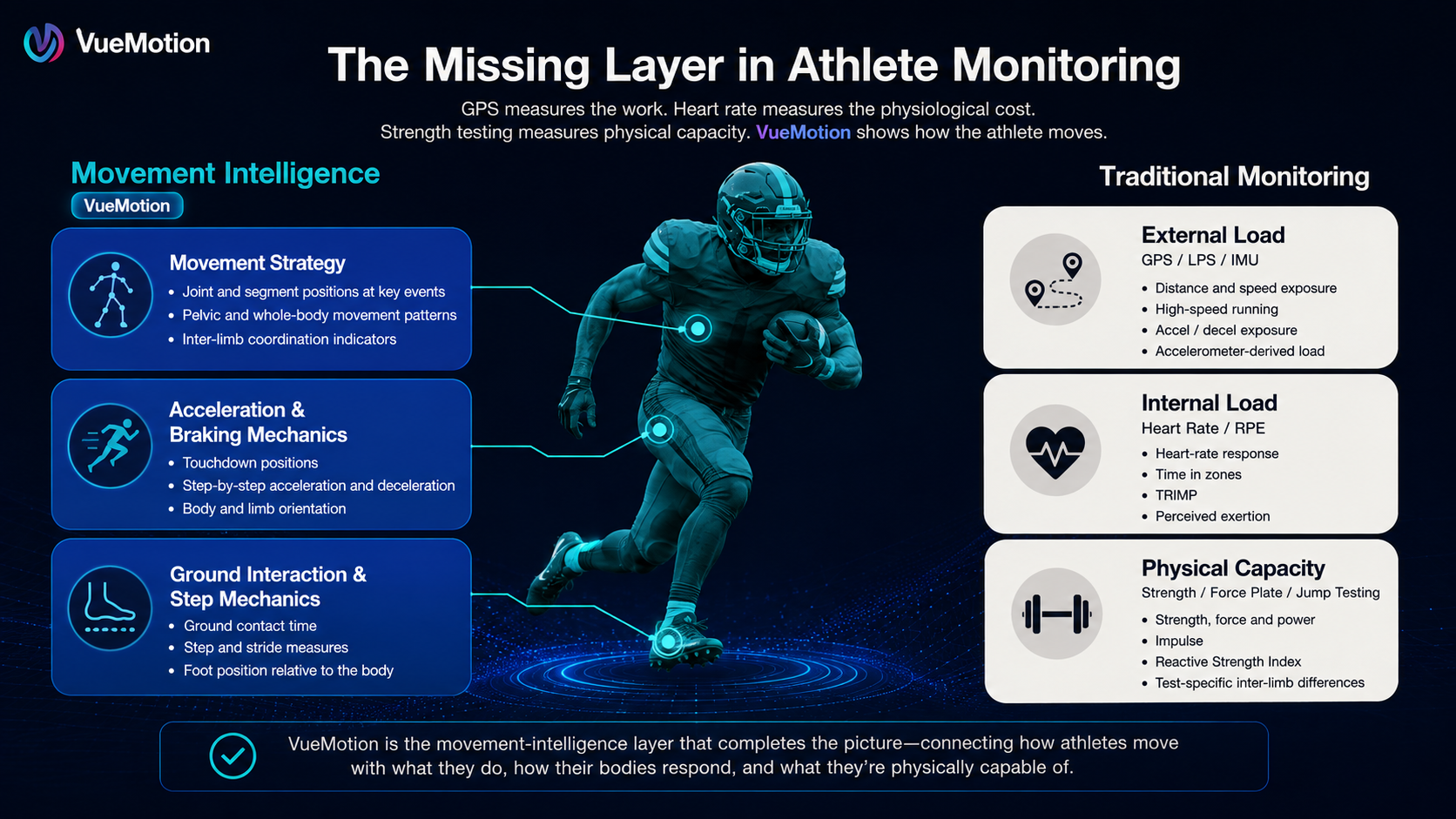
The questions GPS can't answer
Every practitioner has lived some version of these:
The athlete hit their max-velocity exposure target, but how did they produce that speed?
Workload numbers look identical week to week, but is movement quality deteriorating under fatigue?
The rehabbing athlete is back to full running volume, but have they restored their movement strategy, or built a compensation that satisfies the numbers?
Output dropped 4%. What are the kinematic causes?
This is the micro layer: mechanics, symmetry, coordination, ground contact, how force is created, absorbed and redirected. Historically, answering these questions meant a biomechanics lab, markers, force plates and a booking sheet, none of which are practical during an in-season training week.
That's the gap VueMotion closes. A phone or camera at training, AI trained on real-world athlete movement, and lab-grade kinematics delivered from the same sessions your GPS units are already tracking. No wearables, no markers, no lab.
The macro/micro framing is the simplest way to think about it:
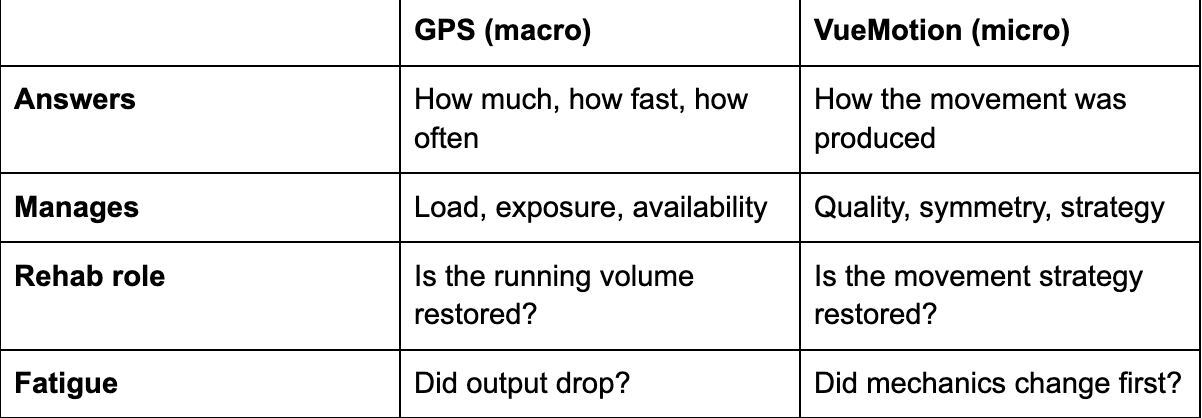
Neither replaces the other. GPS without movement data tells you what happened but not why. Movement data without GPS lacks the workload context that makes it actionable. Together, they answer the question every practitioner actually cares about: Is this athlete producing performance efficiently, sustainably and safely?
Two athletes, same 9.4 m/s. Now you can tell them apart.
VueMotion delivers lab-grade movement analysis from any phone or camera — in the field, at training, from the sessions you're already running. See how clubs like Minnesota Vikings, Charlotte FC and Chicago Fire use it at vuemotion.com